AEO vs SEO in 2026: What Actually Changed, and What to Do About It
Half the marketing world is panicking that SEO is dead. The other half says AEO is just SEO with a new acronym. Both are wrong. Here's the honest, side-by-side breakdown of what AEO is, where it overlaps with SEO, and how to budget your time between them in 2026.
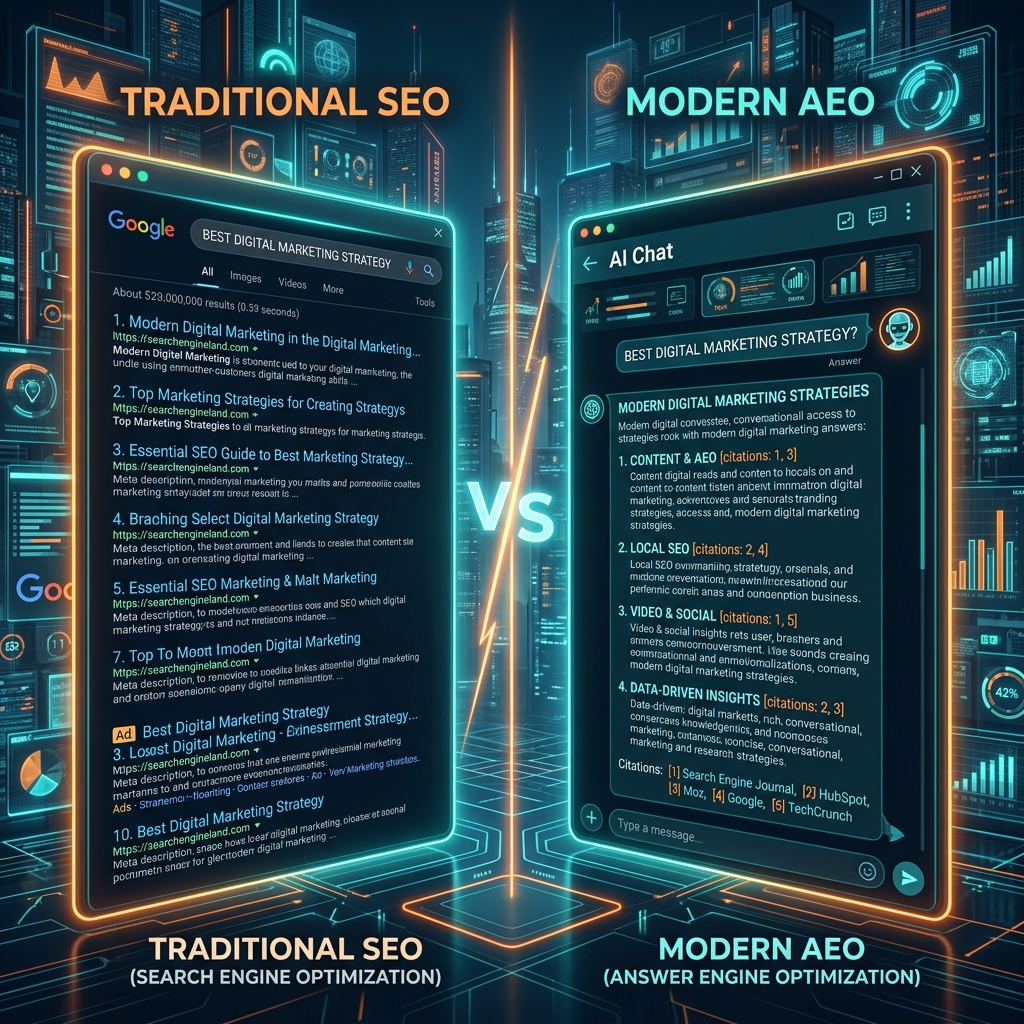
For 18 months now, the marketing world has been split into two camps about AI search.
One camp says SEO is dead — that nobody clicks blue links anymore because ChatGPT and Claude answer everything inline, and you need to abandon old SEO playbooks and rebuild around AEO from scratch.
The other camp says AEO is just SEO with a new acronym — that good SEO has always been about clear, structured content, and rebranding it as "Answer Engine Optimization" is mostly a consultant pitch.
Both camps are wrong, and the truth is more useful than either. AEO and SEO are different disciplines that share roughly 70% of their practices. Confusing them — in either direction — leads to wasted budget and missed traffic.
This post lays out the honest comparison, with the parts that are genuinely new, the parts that are exactly the same, and a 2026 strategy that takes both seriously.
What each one actually is
Before comparing, the definitions need to be tight. Vague definitions are why people keep arguing past each other on this.
SEO (Search Engine Optimization) is the practice of getting your pages to appear as high as possible in the list of results that a search engine shows when a user makes a query. The goal is a click from the results page to your site.
AEO (Answer Engine Optimization) is the practice of getting your pages cited as a source in the synthesized answer that an AI engine returns when a user asks it a question. The goal is to be extracted from, cited, and ideally clicked through for deeper detail.
The difference is not "search engines vs AI." Google's results page now contains AI Overviews above the blue links — the same page is doing both at once. The difference is between ranking in a list and being cited in an answer. Those are different optimization targets even when the same underlying index is feeding both.
The side-by-side comparison
| Dimension | SEO | AEO |
|---|---|---|
| Goal | Rank in a list of results | Be cited in a synthesized answer |
| Primary signal | Backlinks, on-page relevance, authority | Extractability, factuality, citation-worthy structure |
| Content format that wins | Long, comprehensive guides | Direct answers with clear question-shaped structure |
| Click-through model | User picks from 10 results | User reads answer, may click 1 citation |
| Schema priority | Article, Product, Review | FAQ, HowTo, Definition, Q&A |
| Freshness weight | Moderate (varies by niche) | High for time-sensitive topics |
| Brand mentions | Indirect ranking factor | Major signal — AI engines prefer cited brands |
| Keyword targeting | Specific phrases | Question-shaped intents |
| Measurement | Rankings, impressions, clicks | Citation rate, AI referral traffic |
| Compounding behavior | Slow build, durable | Faster build, more volatile |
A few of these deserve unpacking, because they are where the disciplines actually diverge.
Content format
SEO has rewarded long, comprehensive content for years — partly because depth correlates with quality and partly because more content = more keywords to rank for. The rule of thumb has been "if your competitor has 2,000 words on this topic, you need 2,500."
AEO inverts this calculus within a page. AI engines extract chunks of roughly 50–300 words. A 4,000-word post that buries the actual answer to its title 1,500 words in is harder to cite than a 1,200-word post that delivers the answer in the first paragraph and then expands.
The reconciling move is to keep the long-form post (for SEO) but front-load the direct answer (for AEO). The first 100 words become the AEO load-bearing zone; the next 2,000 are the SEO substance.
Schema markup
SEO has spent a decade chasing rich results: review stars, product cards, FAQ accordions, How-to steps. Google has steadily reduced the visibility of most of these in normal results.
AEO has revived schema's importance, but for a different reason. AI engines actively read structured Q&A markup to find extractable answer pairs. FAQ schema, which has almost no visible Google rich result anymore, is now arguably the single highest-ROI markup type because AI engines use it to choose what to quote.
If you removed your FAQ schema in 2023 because it no longer showed in search, putting it back in 2026 is one of the cheapest AEO improvements you can make.
Click-through model
This is the part that genuinely worries publishers, and it deserves an honest answer.
SEO's economic model assumes the user has to choose a result. Ten options on the page. If yours is first, you get most of the clicks; if yours is tenth, you get scraps but you still get something.
AEO's economic model assumes the user reads the AI's answer and may not click anything. Citation rates vary widely by query type — informational queries see lower click-through, while transactional and "show me the source" queries still see real click traffic.
The early data (as of 2026) suggests AEO traffic is lower in volume but higher in intent. Users who do click through from an AI citation have read the summary, decided the source is interesting, and are now seeking depth. That is not a bad audience.
Measurement
This is where AEO is genuinely harder than SEO right now. There is no Search Console for ChatGPT. Citation tracking requires either manual checks or third-party tools that scrape AI answers for your brand.
The minimum-viable measurement setup for AEO:
- Track AI referral traffic in your analytics. Filter for traffic from
chatgpt.com,perplexity.ai,claude.ai,gemini.google.com, and the few other major AI assistant origins. - Manually audit citation rate weekly. Pick 10 target queries; ask the three major AI engines; record whether you are cited.
- Monitor AI crawler traffic in your server logs. Growing OAI-SearchBot, ClaudeBot, and PerplexityBot crawl frequency is an early signal that citations are coming.
It is more work than a Search Console dashboard. The discipline is younger, the tools are immature, and you will have to live with rougher measurement for the next year or two.
Where AEO and SEO overlap (and you can do once, get twice)
It is worth being explicit about how much of the work serves both disciplines. Most of it does.
Things that help SEO and AEO equally:
- Crawlable, fast-loading pages
- Original, factual content with specific examples
- Clear heading structure with descriptive H2s
- Internal linking between related posts
- Real backlinks from credible sites
- Updated content (
lastmodin sitemap) - Author bylines and visible expertise signals
- Genuine answers to genuine reader questions
If you do these well, you cover 70% of AEO without thinking about AEO specifically.
Things that are uniquely AEO (extra effort beyond SEO):
- Question-format H2s with tight answer paragraphs underneath
- FAQ schema on pages with multiple sub-questions
- Direct answer to the page's title within the first 100 words
- Allowing AI crawler bots in robots.txt (see our full guide to ranking in ChatGPT and Claude)
- Citing primary sources from your own content
- Tracking AI referrals and citation rate separately
These are not heavy lifts. Adding them to existing high-traffic pages takes 10–20 minutes per page. The compounding return is meaningful: a page that gets cited by ChatGPT once may keep getting cited for months.
Things that are uniquely SEO (no AEO benefit):
- Title tag character-count optimization
- Meta description CTR copywriting
- Long-tail keyword stuffing in alt text
- Aggressive interlinking purely for PageRank flow
These still help your Google rankings, but they do not move the needle for AI citations. Allocate effort accordingly.
A 2026 strategy: how to split your time
The framework we use on this site to allocate content effort:
| Budget bucket | Allocation | What goes here |
|---|---|---|
| Shared foundation | 60% | Good writing, structure, internal links, factual reporting — serves both |
| AEO-specific | 20% | Question H2s, FAQ schema, first-100-word answers, source citations |
| SEO-specific | 20% | Backlink work, title/meta optimization, keyword research |
The biggest mistake we see (and made ourselves early on) is treating AEO and SEO as a 50/50 split where you build two separate content workflows. That doubles your effort and produces worse content for both audiences.
The correct move is one content workflow with AEO and SEO checks layered in at the right stages of the same draft.
When AEO matters more (and less)
Not every site needs to weight AEO heavily. A few patterns to think about:
AEO matters more for:
- Educational and informational content (definitions, comparisons, how-tos)
- B2B SaaS and tools where users research before buying
- High-trust niches (finance, legal, medical) where citations carry weight
- Topics with active query volume in AI assistants
AEO matters less for:
- E-commerce product pages targeting transactional searches
- Local services where Google Maps and Local Pack dominate
- Highly visual content (Pinterest, Instagram are still where this lives)
- Hyper-recent news where AI engines often refuse to cite anything
If you run a SaaS blog or an informational publisher, AEO should be near the top of your 2026 content priorities. If you run an e-commerce store, traditional SEO and conversion optimization still deserve the bulk of your attention.
Common misconceptions worth correcting
"AI engines will hide my brand." Most major AI engines cite their sources visibly. Claude shows inline links. Perplexity dedicates a whole sidebar to citations. ChatGPT shows source links beneath cited answers. Brand visibility in AI answers is often better than in a traditional results page where users skip to the first organic result.
"Optimizing for AEO will hurt my SEO." The opposite, in our experience. Pages we rewrote for AEO (clearer structure, tighter answers, better citations) saw modest but consistent SEO gains too. Google's helpful-content systems and AI extractability seem to like the same things.
"I can just block AI bots and force traffic back to Google." You cannot. Users who get a partial answer from an AI engine generally accept the partial answer and move on — they do not switch to Google looking for your specific page. Blocking AI crawlers removes you from one channel without recovering traffic in the other.
"AEO is a temporary trend." The interface might evolve, the bots might be renamed, the specific tactics might shift. But the underlying shift — from "list of results" to "synthesized answer with sources" — is structural. Whatever it is called in 2028, the discipline of writing extractable, citation-worthy content will keep mattering.
What we would do if starting from scratch today
If we were launching a new publication in 2026 and had to pick one strategy:
- Week 1: Audit competitors' top pages. Identify the 20 question-shaped queries with real volume and weak AI answers.
- Weeks 2–6: Write 20 pages, one per question. Each page: clear definition in first 100 words, question-format H2s, FAQ schema, real source citations, internal links to related pages.
- Weeks 7–10: Build backlinks the boring old SEO way — guest posts, expert quotes, original data — to make the pages rank in underlying search indexes.
- Weeks 11+: Measure AI citation rate weekly. Update the pages that are cited to keep them current; rewrite the ones that are not.
That sequence covers both AEO and SEO without artificially separating them. By month four, the early citations start compounding. By month six, AI referrals are a measurable channel.
The takeaway
AEO and SEO are not opposites and they are not synonyms. They are overlapping disciplines with a shared foundation and small but real differences at the edges.
The right framing for 2026 is to stop arguing about which one matters more and start building content workflows that serve both. The best SEO has always been about clear, structured, helpful content. AEO is a refinement: the same content, formatted so an AI can read it the way a careful human would.
The publishers who win this transition will not be the ones who pick a side. They will be the ones who quietly do both, write better than their competitors, and let the AI engines — and the humans they answer for — find them.
If you want the tactical layer to go with this strategy, read our companion guide on how to rank in ChatGPT and Claude. And if you are still picking which AI assistant to optimize for first, the ChatGPT vs Claude vs Gemini comparison is the right starting point.
FAQ
Frequently asked questions
What is AEO?
AEO stands for Answer Engine Optimization. It is the practice of structuring your content so that AI answer engines — ChatGPT, Claude, Perplexity, Google AI Overviews — extract from it and cite it in their generated answers. AEO is a subset of search optimization that focuses on extractable, citable content rather than blue-link rankings.
Is AEO replacing SEO?
No. AEO is layering on top of SEO, not replacing it. The major AI answer engines all draw from search indexes (ChatGPT uses Bing, Google AI Overviews uses Google, Claude uses Anthropic's provider, Perplexity uses its own index). If your page does not rank in those underlying indexes, AI engines will not see it. SEO remains the foundation; AEO is what determines whether you get cited once you rank.
What is the main difference between AEO and SEO?
SEO optimizes for being one of ten results on a results page where the user chooses what to click. AEO optimizes for being the source an AI engine cites in a single synthesized answer. The practical differences: AEO weighs structured Q&A formatting, FAQ schema, definition pages, and citation-friendly source links more heavily than SEO does.
Should I do AEO or SEO first for a new website?
Do both at the same time — the work overlaps by about 70%. The 30% that is uniquely AEO (question-format H2s, FAQ schema, direct first-paragraph answers, source citations) takes only a small amount of extra effort per page and pays off in both AI citations and traditional rankings. Skipping AEO costs you future AI traffic; skipping SEO means AEO never gets a chance to kick in.
Does AEO traffic convert worse than SEO traffic?
Not necessarily, but the patterns are different. AEO referrals (clicks from ChatGPT, Claude, Perplexity citations) tend to come from users already deep in research mode — they have read the AI summary and are clicking through to verify or go deeper. Conversion intent is often high, but volume per page is lower than equivalent Google rankings. Most publishers see AEO as a quality-leaning traffic channel rather than a volume play.
Will AEO eventually replace traditional SEO?
Unlikely within the next few years. Traditional SERPs and AI answer engines are converging — Google now puts AI Overviews above blue links, and ChatGPT shows source citations. The end state is more likely a hybrid where every search experience blends generated answers with linkable sources. AEO and SEO will keep merging into a single discipline.
Tagged