What Are AI Agents, Really? A Plain-English Guide for Normal People
Everyone keeps saying 'AI agents' like you already know what they mean. Here's the honest, no-jargon version: what an agent actually is, how it's different from a chatbot or a Zapier automation, and where they're genuinely useful today versus where you still shouldn't fully trust them.
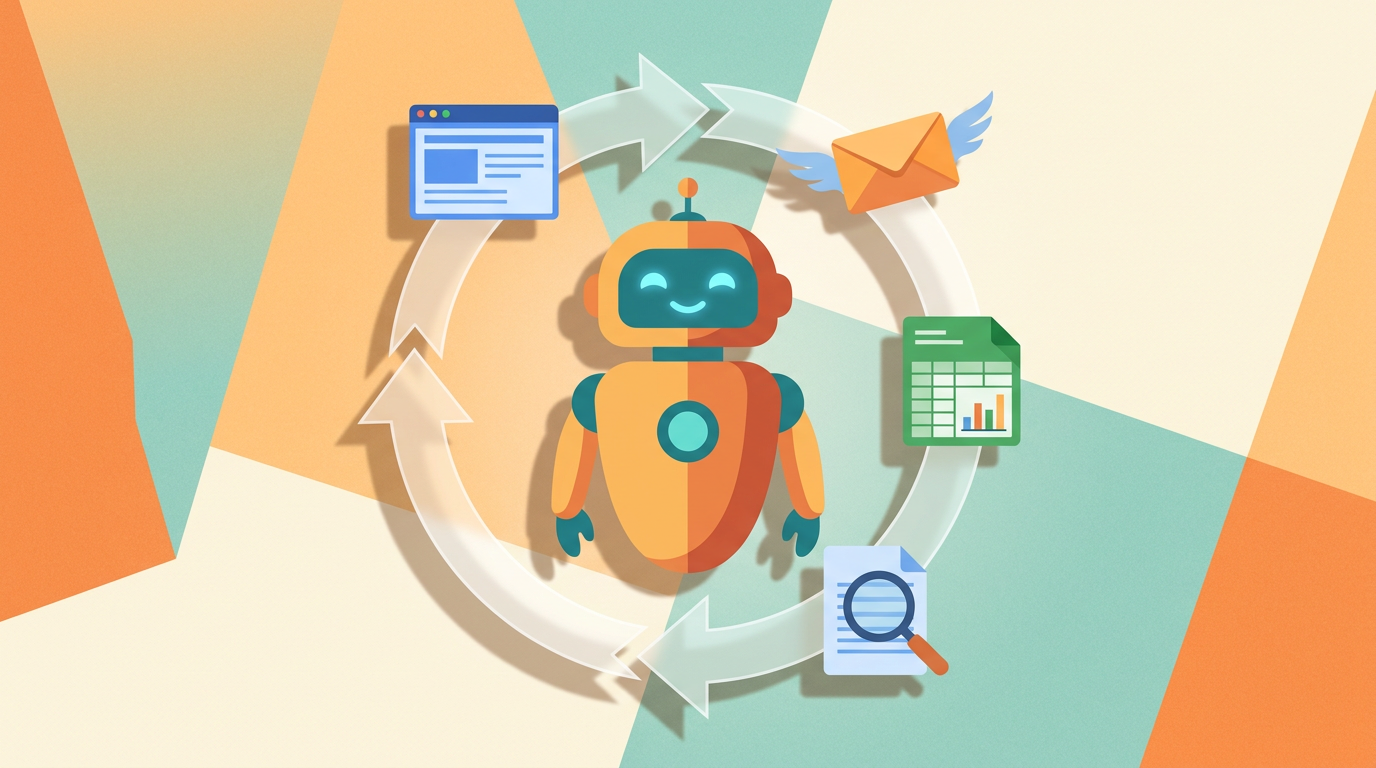
If you keep hearing "AI agents" and quietly nodding along, here's the plain version. So what are AI agents? An AI agent is software you hand a goal to, and it works out the steps to reach that goal on its own, using tools like a web browser or your email. That's the whole idea. A chatbot just answers you. An automation fires the same fixed steps off a trigger. An agent's the odd one out: you give it a goal and it works out the steps itself.
That one distinction does most of the work, so it's worth slowing down on it before we get into what agents can and can't actually do in 2026.
The three things people confuse with each other
Most of the confusion comes from lumping three different things under "AI." They feel similar because they all involve a computer doing something clever, but they behave very differently.
A chatbot is reactive. You type, it replies, it stops. It has no goal of its own and it doesn't do anything in the world. If you ask ChatGPT to draft an email, it gives you the text, and then you copy it into Gmail and hit send. The chatbot never touched your inbox. The big ones, the major AI chatbots like ChatGPT, Claude, and Gemini, all started life this way, as very good text predictors that talk back.
An automation is fixed and trigger-based. When a new row appears in a sheet, send a Slack message. Every time, the same way, no judgment involved. This is the world of traditional automation tools like Zapier, Make, and n8n. It's reliable precisely because it never improvises. If the situation changes in a way the builder didn't plan for, the automation either breaks or does the wrong thing without noticing.
What are AI agents actually doing under the hood?
An agent sits in the middle and adds the part that's new: it decides. You give it an objective, and it loops. It looks at the goal, tries something, sees what came back, then decides the next move. It keeps going until it thinks it's done or it gets stuck. That loop is the actual definition.
Say you tell an agent: "Find three local web designers, check their portfolios, and put their names, sites, and contact emails in a spreadsheet."
A chatbot would give you a guess from memory, possibly with made-up details. An automation couldn't do this at all unless someone pre-built every step. An agent, in theory, searches the web, opens a few results, reads the pages, notices that one is a marketing agency rather than a designer and skips it, finds the contact pages, and fills in the sheet. Nobody told it to skip the agency. It worked that out from the goal.
When it works, it's genuinely a little eerie watching it skip the agency on its own. The honest part is that it doesn't always work. The agent might grab two real designers and one place that closed last year, because it can't reliably tell. It might decide a "Contact us" form counts as an email and leave that cell wrong. The loop is powerful, but each step is a place it can drift off course, and the errors compound.
Where agents are actually useful in 2026
I've found agents earn their keep on tasks that are boring, hard to get badly wrong, and quick to check after.
Research gathering is the strongest case. "Pull together what these five companies charge and how they position themselves" is real work that an agent can do a decent first pass on while you do something else. You still verify it, but it saved you the clicking.
Repetitive digital chores are the second. Renaming and sorting files, reformatting messy data, pulling specific fields out of a stack of documents. Boring, mechanical, and the kind of thing where a wrong result is obvious the moment you look.
Drafting that involves a few steps also fits. An agent that reads a long thread, checks your calendar, and drafts a reply proposing times is doing more than a chatbot can, and the worst case is you edit the draft. A lot of grounded AI productivity apps you can use today are really just narrow, supervised agents under the hood, even when they don't put the word "agent" on the box.
Where agents fall apart
Here's the part the demos don't show you. Agents are unreliable in ways that matter the second the stakes go up.
They misread instructions and act on the misreading with full confidence. A chatbot that misunderstands you just gives a bad answer you can ignore. An agent that misunderstands you takes an action, and if that action sends an email or spends money, you can't un-send it.
They also get worse the longer the task runs. A small mistake early, like grabbing the wrong date, gets carried forward and built on. Ten steps later the agent is confidently working from a wrong assumption it made on step two. And they can get stuck in loops, repeating the same failing action because nothing tells them to stop and ask for help.
So I don't let an agent do anything irreversible without me approving the step. Money, anything sent in my name, anything I can't get back. For those, the agent proposes and I press the button. The convenience of full autonomy isn't worth a confidently wrong action I have to clean up.
Can you build one yourself without coding?
You can, for narrow personal stuff, without touching code. The simplest on-ramp is building a custom GPT with your own instructions and, where available, a few connected actions, which can give you a simple assistant that follows your instructions. Some no-code automation platforms have also started adding agent features on top of their existing app connections, so you can pair a language model with the many integrations they already support.
What you won't get this way is anything truly sophisticated or fully trustworthy. These home-built agents are best aimed at one specific, repeated task you understand well enough to spot when it goes wrong. That narrowness is exactly why it works. The narrower the job, the more useful the agent.
So what's an agent, in one line
An AI agent is just software that takes a goal and chooses its own steps to reach it, using tools. That's the line between an agent, a chatbot that answers when asked, and an automation that runs fixed steps on a trigger. In 2026 agents are real and useful for the dull stuff you can eyeball afterward, and still too unreliable to trust unsupervised on anything that costs money or can't be undone.
If you want to start somewhere concrete, get comfortable with the major AI chatbots like ChatGPT, Claude, and Gemini first, then try building a custom GPT for one small job you do over and over. You'll learn more from one small working agent than from any explainer, this one included.
FAQ
Frequently asked questions
What is an AI agent in simple terms?
An AI agent is software you give a goal to instead of step-by-step instructions, and it figures out the steps itself and uses tools to get there. A chatbot waits for you to ask each question. An agent takes one objective, like 'find me three suppliers and email them for quotes,' and works through it on its own. The key difference is that it decides what to do next rather than following a fixed script.
What is the difference between an AI agent and a chatbot like ChatGPT?
A chatbot responds to one message at a time and then stops; it doesn't act in the world unless you copy its answer somewhere yourself. An agent runs a loop, takes actions like searching, clicking, or sending, and keeps going until the goal is met or it gives up. Plain ChatGPT is a chatbot, though several of these companies have begun offering more agent-like modes that can take some actions on their own.
Are AI agents the same thing as automation tools like Zapier?
No, though they overlap. A Zapier or Make automation runs the exact same fixed steps every time a trigger fires, and it does nothing it wasn't explicitly told to do. An agent decides its own steps based on the situation, which makes it more flexible but also less predictable. For repeatable, well-defined tasks, traditional automation is usually more reliable; agents shine when the steps can't be known in advance.
Can I build my own AI agent without coding?
Yes, to a point. Tools that let you build a custom GPT or assistant with instructions and connected actions get you a basic agent without writing code. Some no-code automation platforms have also started adding agent-style features that pair a language model with their existing app connections. You won't build anything cutting-edge this way, but for narrow personal tasks it's very doable.
Are AI agents safe to let run on their own?
For low-stakes, reversible tasks, yes. For anything involving money, sending messages on your behalf, deleting files, or making commitments, no, not unsupervised. Agents still misread instructions and confidently take wrong actions, and unlike a chatbot's wrong answer, a wrong action can have real consequences. Keep a human approving the steps that actually matter.
Tagged